This one was supposed to be easy. I guess it could have been, had I known any chill. But I am a chill-free zone, and so I labour with unwarranted obsession to create a qualitative version of a creature I have never even considered using at the table…
Anyway, the Little Brown Books tell us:
The beautiful tree sprites of mythology, Dryads are each a part of their own respective tree and will stay within 24" of their trees. They are shy and non-violent, but they have a powerful Charm Person spell with a +10% chance of succeeding, and anyone who approaches/follows a Dryad is likely (90%) to have the spell thrown at him. Anyone charmed by a Dryad will never return from the forest. Dryads have exact knowledge of the woods around them. (Monsters and Treasure p. 16)
Amount: 1-6 ; AC: 5; Movement: 12; HD: 2; In Lair: 20%; Treasure type: D (some copper, silver, gold, gems and jewelry, and magic items). (ibid. p. 4)
At first glance these seem rather harmless, but if you approach them upon encountering them there is a pretty high chance you’ll lose a character. The +10% I think means you need to roll +2 higher on a d20 to make the saving throw, and as charmed characters are basically dead (they ‘will never return from the forest’), those are some really harsh odds. A far more formidable foe than you would think.
But once a party knows this, there is absolutely no reason to ever approach encountered Dryads and risk losing a character, and as they don’t approach the players themselves this turns them basically into flavour encounters. If I understand this correctly that is a really weird design choice.
I suppose their knowledge of the surrounding area might incentivise players to approach them, but the risk seems way too high for it to be worth it.
Also interesting that they are only 20% of the time in a lair, but cannot venture far from their tree. What is a Dryad lair then? Would that be them in their tree, as opposed to chilling just off the side of it? Again, curious design if I am not somehow mistaken.
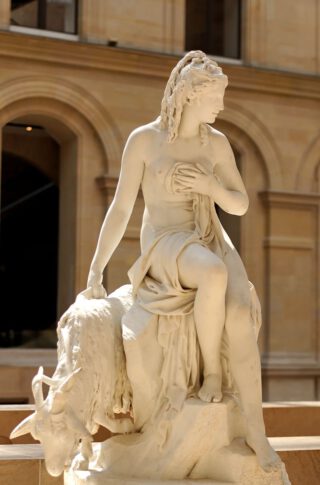
As alluded to in the intro, I thought it would be easy to refer to an old source to spice these bland branches up a bit. However, I quickly found that to be more difficult than I had assumed. It seems that most of the ancient authors that refer to dryads sort of assume the reader knows what they are. Even Hesiod, whom I used for the Chimera, was basically useless to me.
Instead I’ll use the book Greek Nymphs: Myth, Cult, Lore by Jennifer Larson. I feel justified in using a book on nymphs as a source on dryads given that dryads are a certain kind of nymph:
‘Sources of widely varying date elaborate the basic motif of the hamadryad into narratives about heroes’ encounters with these tree-dwelling nymphs.’ (Greek Nymphs, p. 73)
Nymphs that dwell in trees are given only a single unique characteristic to differentiate them from other nymphs: Their wellbeing is tied to the wellbeing of their tree. As described in an excerpt from the Homeric Hymn to Aphrodite Larson includes:
“But when they are born, pines or high-topped oaks spring up with them upon the fruitful earth, beautiful lush trees standing high on the lofty mountains. They call them the sanctuaries of the immortals, and mortals never cut them with an ax. But when the fate of death is near, first those lovely trees wither where they stand, and the bark shrivels about them and the twigs fall, and the soul of both [nymph and tree] leaves the light of the sun together.” (ibid, p.33. Translated from ancient Greek by Larson).
Nothing else of note is said about dryads specifically, though nymphs more generally have some interesting features:
‘In the Greek imagination, nymphs are inseparable from the landscape. To a greater degree than most other Greek deities, they are closely associated with certain topographical features. The most basic of these is the spring, for nymphs are above all deities of water.’ (ibid, p.8)
Water deities, tied to the land. Makes me think of animism, with nymphs as divine expressions of water features.
‘The word numphê is used from the beginning to mean both “bride” and “female water/landscape deity’ (ibid, p.21)
‘Any spot that is refreshingly cool, green, and pleasing to the eye might be the abode of nymphs.’ (ibid, p.10)
‘The nymphs, on the other hand, are neither good nor evil, for the gods of classical antiquity did not exist on a moral spectrum of the Christian type.’ (ibid, p.88)
All nymphs are female, and their name means bride (or the word for bride means nymph, I am not sure on the etymological order). They prefer places that are nice for most living creatures, be they human or herd animals. The combination gives us a potentially fun interpretation of nymphs as the ‘better halves’ of a more cruel or at least callous nature in general. We wanna worship and chill with the nymphs because in general they are pretty chill.
Which seems to be what people historically did, the book describes various sites of worship dedicated to nymphs as well as the concept of ‘nympholepsy’:
‘which is a blanket word that can be used to describe several overlapping concepts. First and foremost, as Connor has shown, the term refers to a heightening of awareness and elevated verbal skills believed to result from the nymphs’ influence on a susceptible individual. It is in this sense that Boiotian Bakis was inspired to produce oracles, and it is this form of nympholepsy to which Sokrates alludes when he playfully announces that he is on the verge of speaking in dithyrambs under the influence of the nymphs of Ilissos (1.2). In such contexts, poetry and prophecy, always closely related, cannot be separated, and the nympholept, like the poet, the Sibyl, or the Pythia, experiences a state of divine madness but not one that his or her contemporaries would regard as pathological.’ (ibid. p.13)
So they can sort of possess you, causing you to become divinely inspired. As you can imagine, achieving a state like that was deemed desirable, causing typically men to dedicate their lives to serve local nymphs, which is another way the term nympholepcy is used:
‘[…] the term nympholept could be used to describe someone who exhibited an unusual degree of religious devotion to the nymphs.’ (ibid, p.14)
But nymphs aren’t wholly passive when it comes to gathering followers, which gives us a final use of nympholepsy: Abduction by nymphs.
‘Another sense of the term nympholepsy [...] is that of physical rather than mental rapture by the nymphs. In mythology and cult, we have Hylas, Bormos, and Dryope, who were snatched away into the company of the nymphs, and in funerary inscriptions, we find that children or young women were sometimes said to have been so abducted or received.’ (ibid, pp.13-14)
And having been abducted, often meant joining the nymphs in more than one sense of the word:
‘Dryope, the Thessalian shepherdess who bore a son, Amphissos, to Apollo, was such a favorite of the hamadryad nymphs that they later snatched her and made her one of themselves.’ p.70
Abduction ties into a specific position nymphs, and by extension dryads, have in Greek mythology: Being sexually dominant despite being female. This gives them a strange, almost transgressive funtion in traditional ancient Greek society:
‘Abduction (like the fulfillment of sexual desire) is the prerogative of the more powerful over the weaker: Olympian over nymph, immortal over mortal, older over younger, and male over female, to the Greek way of thinking. Thus abductions of mortals by nymphs fit the expected pattern in one way (immortal over mortal) and reverse it in another (female over male).’ p.66
‘All the accounts of goddess-mortal unions I have so far discussed have at their root the same male fear of placing oneself at the mercy of a more powerful female (with, perhaps, an attendant unconscious attraction to this idea). The reversal of expected gender roles creates a powerful anxiety that is completely absent when gods have their way with mortal maidens.’ p.83
Nothing scares a man more than a woman treating them the way they treat women, at least that seems to be a theme in ancient Greek poetry about unions between mortal men and nymphs.
I have no real interest in making nymphs specifically scary to straight men, but this idea of being treated the way we treat others as kinda scary is something I do like. To me it often seems like humans in general treat the world as 'for us', causing us to exploit natural resources without any regard for existing ecologies and treating non human animals in ways that are honestly quite abhorrent. So what if this is how nymphs treat humans and other mortals? That might add some less specifically hetero-masculine and more anthropocentric anxiety in having to deal with them.
The final quality nymphs in general have that I have yet failed to mention is their relevance to pastoral parts of society:
‘The nymphs are variously said to teach divination and a range of pastoral skills; they are especially associated with beekeeping.’ (ibid, p.87)
This is also seen in the usual kinds of mortals nymphs canonically hook up with: shepherds. The book details a bunch of examples, but none is by itself relevant enough to mention.
So this is quite a lot. Lets see if I can manage to turn it into something useable at the table:
Nymph (Dryad)
Traits:
- Large (as a tree), runs (like a mountain stream), shimmering (like falling water)
Strengths:
- Divine being: Being divine, they can foretel futures, interpret omens, and commune with other divinities.
- Enchanting: Their mere presence is intoxicating, making those around them more agreeable. If they so desire, no mortal can refuse them.
Weaknesses:
- Water Bound: They can’t move out of sight of the landmark they are bound to, whether that be tree, stream, spring or straight. When they perish, so does the landmark and vice versa.
- Easily Flattered: It takes little to stay on their good side. Pleasantries and symbolic offerings suffice.
Ecology:
- Higher Standing: They are better than you and know it. If you behave like a pest, they’ll try to eradicate you; if you take their fancy, they’ll make you their pet.
- Diligent Esthetes: Their pursuit of beauty combined with near endless time account for the unmistaken natural beauty they cultivate around their abodes.
No comments:
Post a Comment